Mathematics
The goal of the Mathematics Department is that all of our students understand and appreciate the mathematics they are studying; that they can read it, write it, explore it, and communicate it with confidence; and that they will be able to use mathematics as they need to in their lives.
We believe that problem solving (investigating, conjecturing, predicting, analyzing, and verifying), followed by a well-reasoned presentation of results, is central to the process of learning mathematics, and that this learning happens most effectively in a cooperative, student-centered classroom.
We see the following tenets as fundamental to our curriculum:
- that algebra is important as a modeling and problem-solving tool, with sufficient emphasis placed on technical facility to allow conceptual understanding;
- that geometry in two and three dimensions be integrated across topics at all levels and include coordinate and transformational approaches;
- that the study of vectors, matrices, counting, data analysis, and other topics from discrete mathematics be woven into core courses;
- that computer-based and calculator-based activities be part of our courses;
- that all topics be explored visually, symbolically, and verbally;
- that developing problem-solving strategies depends on an accumulated body of knowledge.
Our intention is to have students assume responsibility for the mathematics they explore—to understand theorems that are developed, to be able to use techniques appropriately, to know how to test results for reasonability, to learn to use technology appropriately, and to welcome new challenges whose outcomes are unknown.
To implement this educational philosophy, members of the PEA Mathematics Department have composed problems for nearly every course that we offer. The problems require that students read carefully, as all pertinent information is contained within the text of the problems themselves—there is no external annotation. The resulting curriculum is problem-centered rather than topic-centered. The purpose of this format is to have students continually encounter mathematics set in meaningful contexts, enabling them to draw, and then verify, their own conclusions.
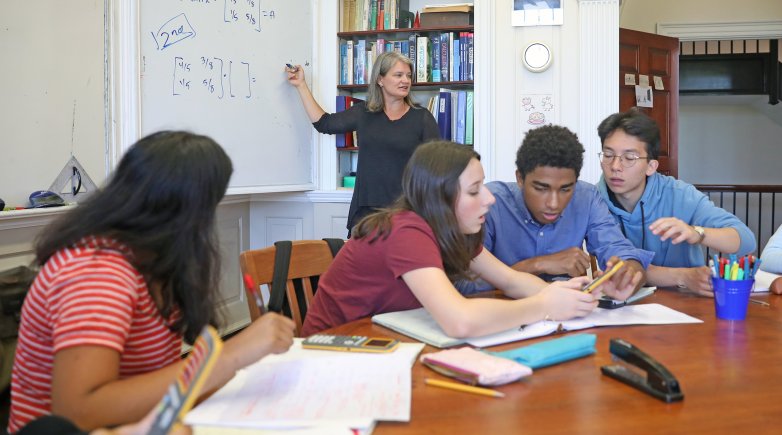
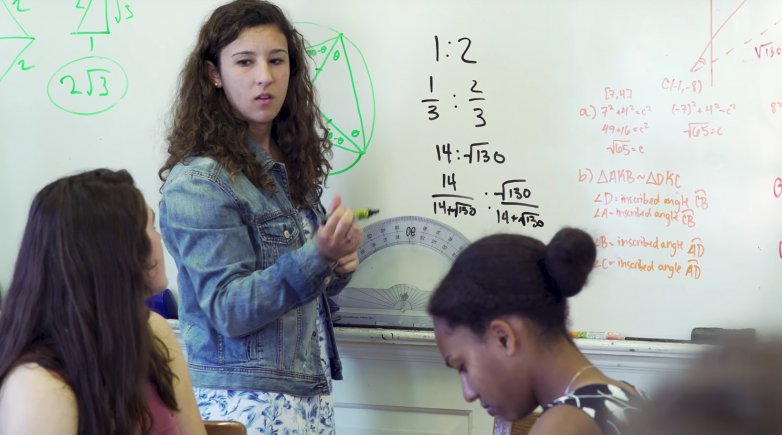
As in most Academy classes, mathematics is studied seminar-style, with students and instructor seated around a large table. This pedagogy demands that students be active contributors in class each day; they are expected to ask questions, to share their results with their classmates, and to be prime movers of each day's investigations. The benefit of such participation in the students' study of mathematics is an enhanced ability to ask effective questions, to answer fellow students' inquiries, and to critically assess and present their own work. The goal is that the students, not the teacher or a textbook, be the source of mathematical knowledge.
Note: Math courses through Math 310/311, plus most Transition Mathematics courses, meet during the reserve formats, therefore meeting approximately 10 more times per term than courses numbered greater than 311.